

My emotional puzzle: a didactic unit to understand what we think, what we feel and what we do
Published on 9 July 2026
Many teenagers experience their emotions as something that simply “happens to them”. An exam, an argument with a friend or a presentation in front of the class comes along, and the emotion appears without warning. In the LIFE SKILLS needs analysis, Italian students pointed precisely to emotional management —identifying what they feel and calming stress— as one of the skills they find hardest. And it is not only an Italian issue.
That is why we have devoted one of the project’s didactic units to emotional intelligence. It is called “My emotional puzzle: the three pieces of what I feel” , and it is now ready.
The three pieces of the puzzle
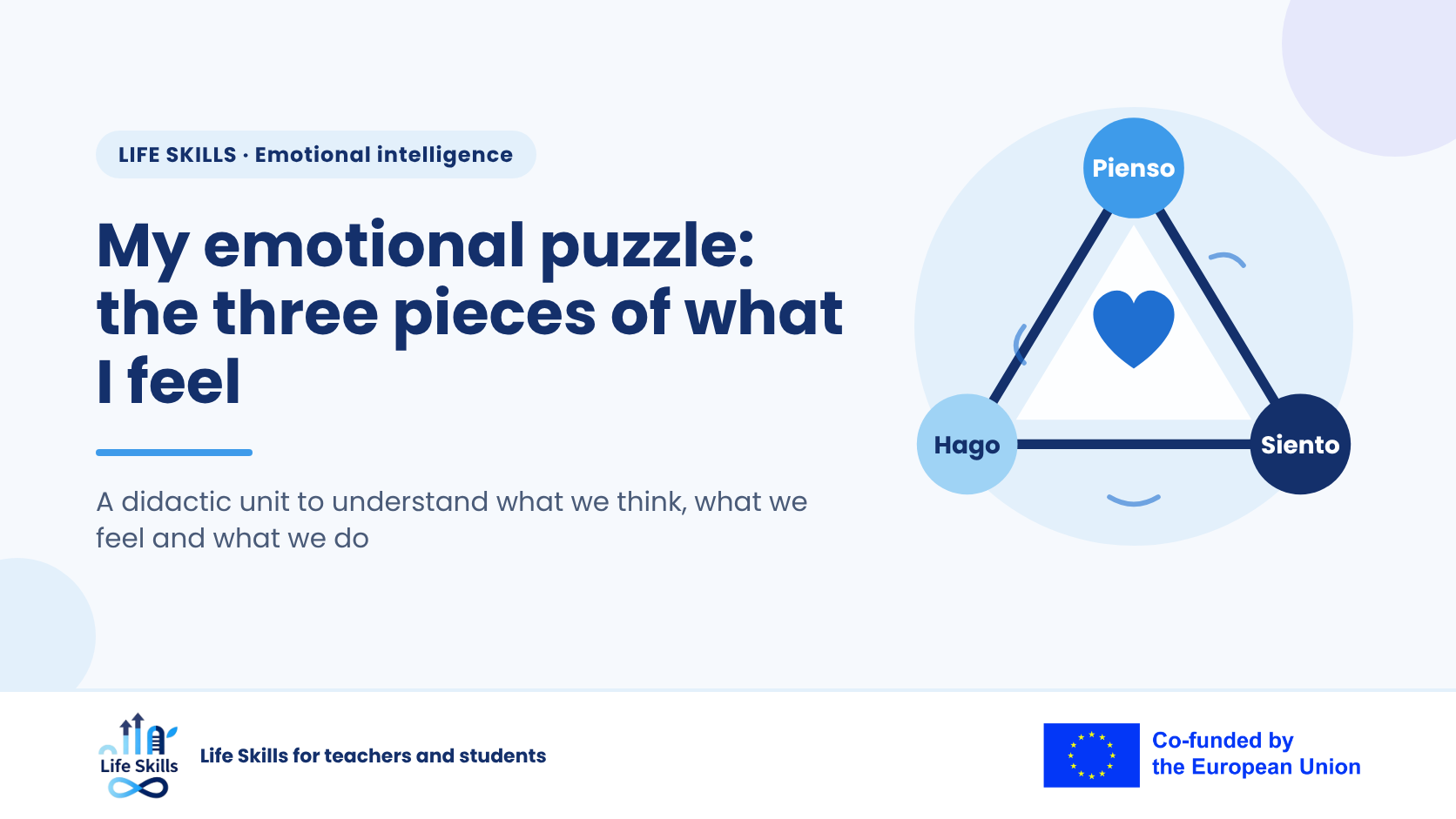
The unit works with the so-called emotional triangle, a simple, visual tool showing that an emotion is not just what we feel, but three pieces that happen at the same time and influence one another:
- What I think: how I interpret what is happening (“I’m going to make a fool of myself”, “it’s normal to feel nervous”).
- What I feel in my body: a racing heart, tension, a knot in the stomach.
- What I do: taking part or avoiding, asking for help, reacting impulsively.
If one piece changes, the others change too. Understanding this helps students realise they have more room for manoeuvre than they thought.
Three sessions, three ways to regulate
Over three 50-55-minute sessions, students start from everyday situations (failing an exam, being left out of a group, scoring a goal), build their own emotional triangle from a real experience and explore a strategy for each piece:
- Cognitive restructuring, to learn to spot and question “thinking traps”: all-or-nothing thinking, catastrophising, mind reading or unfair comparison with other people’s edited image.
- Relaxation techniques, such as diaphragmatic breathing, muscle relaxation or a body scan, to “send calming signals” to the body.
- Active coping, to identify people, activities and resources that help restore well-being.
The unit closes with a dialogue circle and a take-home worksheet, “My own emotional toolkit”, in which each student gathers the strategies that work best for them.
Regulating is not eliminating
If one idea runs through the whole proposal, it is this: the goal is not to stop feeling unpleasant emotions or to feel good all the time, but to better understand how our emotional world works and to have more resources to face difficulties in a healthy way. Emotions are part of the human experience; what we can learn is to influence their intensity and respond in a more adaptive way.
Designed for any classroom
Like the rest of the LIFE SKILLS materials, the unit follows the principles of Universal Design for Learning: it allows different degrees of personal disclosure (students can work with fictional cases or film characters), flexible response formats and breaks for anyone who needs to regulate during the session. Activities that use digital tools such as Mentimeter include an analogue alternative —anonymous answers on paper in a box— so that nobody is left out for lack of resources. And if time is tight, the activities can be spread across the school year in 15-20-minute weekly slots.
All project materials will be free and published under an open licence. If you would like to put them into practice at your school, get in touch.
Disclaimer
The project “LIFE SKILLS – Life Skills for teachers and students: Journey to Wellbeing, Personal Growth, Emotional Management and, Organisation and Productivity Skills” (2024-2-BE02-KA210-SCH-000292934) is co-funded by the Erasmus+ Programme of the European Union. The content of this publication is the sole responsibility of the Active Learning Association, RHIZO 05 and Liceo Classico Federico Frezzi – Beata Angela, and neither the European Commission nor EPOS, the Belgian (Flemish) Erasmus+ National Agency, can be held responsible for any use that may be made of the information it contains.


