

Listening first: how stakeholder feedback is shaping the SAVET Self-Assessment Handbook
Published on 22 April 2026
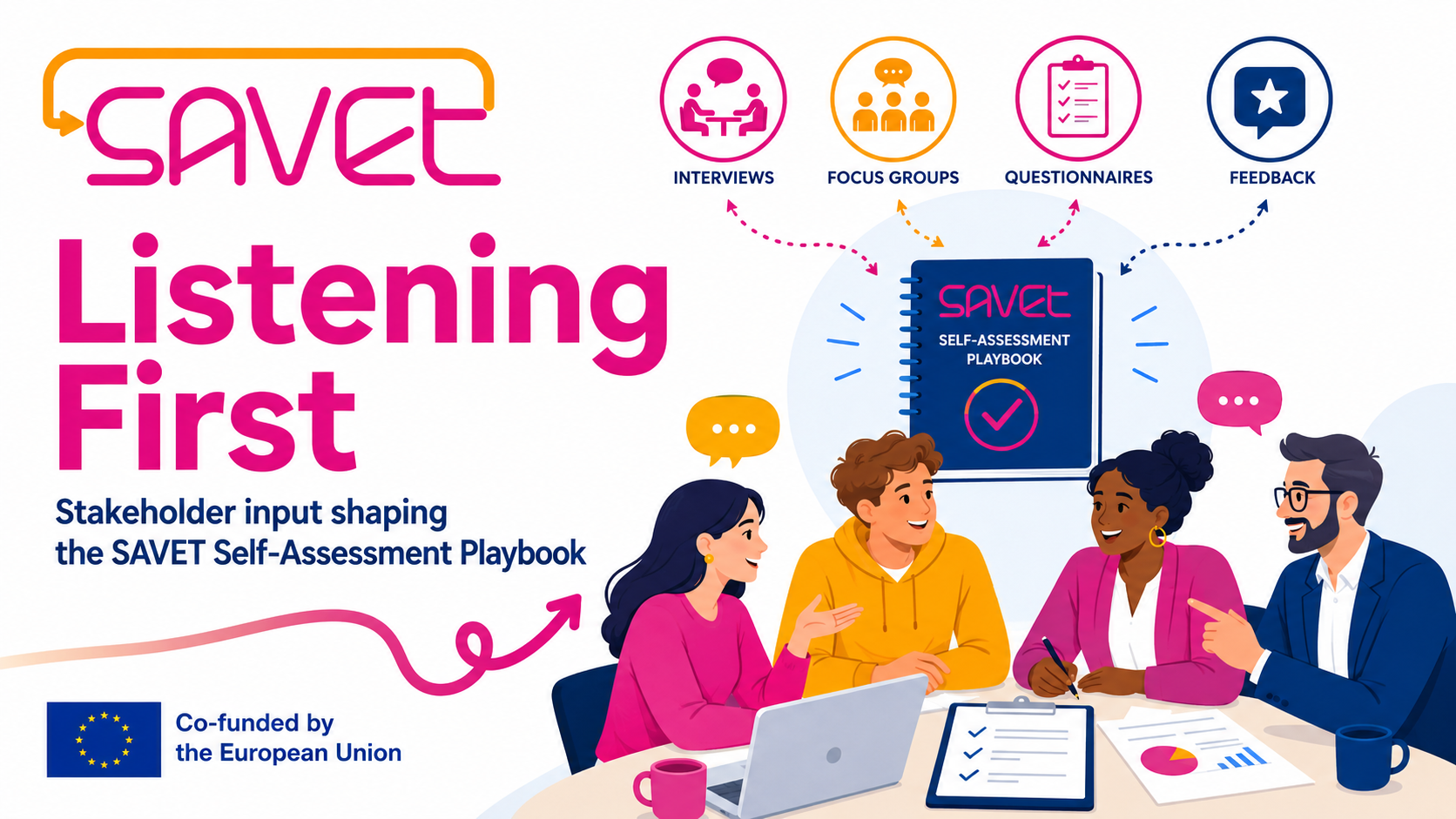
Before developing tools, training materials and classroom strategies, the SAVET project began with an essential step: listening to the people directly involved in vocational education and training.
As part of Activity A1 – Development of the Self-Assessment Handbook, the project partners gathered input from VET stakeholders in Belgium, Spain and Malta. This included contributions from VET teachers, learners, administrators and other education stakeholders through questionnaires, interviews and focus groups.
The purpose of this process was clear: to ensure that the future Self-Assessment Handbook responds to the real needs of VET classrooms.
Self-assessment is not simply about learners giving themselves a mark. In the SAVET project, self-assessment is understood as a set of strategies that help learners reflect on their progress, recognise their strengths, identify areas for improvement and take greater responsibility for their own learning.
This is especially important in vocational education and training, where learners must develop not only technical skills but also autonomy, adaptability, critical thinking and lifelong learning habits.
Through the needs analysis phase, the SAVET partnership explored important questions such as:
- How familiar are VET teachers with self-assessment strategies?
- What barriers do teachers face when using self-assessment in the classroom?
- What kinds of tools, templates or guidance would make implementation easier?
- How do learners currently reflect on their own learning?
- What kinds of classroom activities help learners become more independent and self-regulated in their learning?
The feedback gathered is now helping the project partners shape the Self-Assessment Handbook for VET teachers. The Handbook will offer evidence-based strategies, practical classroom guidance, inclusive approaches and useful resources to support teachers in applying self-assessment effectively.
The results of the needs analysis will also inform the development of the teacher training sessions, the future classroom pilots and the creation of self-assessment examples and templates for VET.
The SAVET project is based on a simple but important principle: effective educational tools must be built on the real needs of the classroom.
By listening first, the partnership ensures that the Self-Assessment Handbook is not just a theoretical document, but a practical guide that supports VET teachers and helps learners become more reflective, autonomous and better prepared for lifelong learning.
Disclaimer
The project «Self-Assessment Mastery for Lifelong Learning in VET» is co-funded by the Erasmus+ Programme of the European Union. The content of this publication is the sole responsibility of RHIZO2, ACTIVE LEARNING ASSOCIATION and MALTA VOCATIONAL LTD, and neither the European Commission nor EPOS, the Belgian (Flemish) Erasmus+ National Agency, can be held responsible for any use that may be made of the information disseminated here.